Is Passwordless Authentication Secure? What the 2026 Data Actually Shows
Yes, passwordless authentication is secure and it is significantly more secure than passwords alone. The 2026 data confirms it at scale. Passkeys, the leading form of passwordless authentication, use public-key cryptography tied to a trusted device and unlocked with a biometric or PIN, meaning no reusable secret is transmitted during sign-in and phishing sites cannot capture or replay the credential.
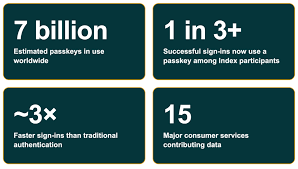
As of 2026, there are approximately seven billion passkeys in active use worldwide, with 90% consumer awareness, a 93% login success rate (versus roughly 63–75% for traditional passwords), and a measurable reduction in credential-driven breaches wherever they are deployed.
Passwordless authentication via passkeys is phishing-resistant, cannot be guessed or reused, and eliminates the shared secret that drives the majority of credential breaches. It is not perfect but the 2026 evidence shows it is the strongest widely-available form of user authentication.
What the 2026 numbers say
The data comes primarily from the FIDO Alliance, IBM, Microsoft, and Verizon which are the most widely cited sources in credential-security research. Here is what they report, as of 2026.
Adoption
- Around 7 billion passkeys in active use worldwide (FIDO Alliance, 2026 Passkeys Index).
- 90% consumer awareness of passkeys, up from 75% in 2025 (FIDO Alliance 2026).
- 75% of consumers have enabled a passkey on at least one account; 49% use one whenever available (FIDO 2026).
- 68% of organisations are deploying, piloting, or rolling out passkeys for employee authentication (FIDO / Descope 2026).
- Microsoft confirmed passkeys will become the default in Entra ID on 1 September 2026, with native SMS/voice MFA retired from 1 February 2027 (Microsoft).
Security effectiveness
- 93% login success rate for passkeys vs 63–75% for passwords (Microsoft, via Security Boulevard), meaning fewer lockouts and fewer frustrated workarounds.
- Passkeys eliminate the shared secret entirely. No password, no one-time code, no reusable token is transmitted. A phishing site has nothing to capture or replay.
- Passwordless deployments report up to 91% fewer credential-related security incidents (industry analysis, 2026).
The problem passkeys solve — by the numbers
- 22% of breaches in 2025 used stolen credentials as the initial access vector (Verizon DBIR 2025, via Swif) — the single most common initial entry point.
- 7,000+ password attacks per second, with 97% of identity attacks taking the form of password spray (Microsoft Digital Defense Report).
- $4.67M average cost per credential-driven breach (IBM 2025); the 2026 edition pushed the global average to $4.99M (IBM, via Stingrai).
- 33% of consumers reported a confirmed account compromise or breach notification in the past year (FIDO 2026). Passwords are not holding.
- 19% of all login attempts on SSO providers are credential stuffing (Verizon 2025 DBIR) — automated attacks using stolen credentials.
So where is it not secure? The honest gap
In August 2026, independent researchers from SpecterOps and Palo Alto’s Unit 42 published findings demonstrating that passkeys can be compromised when the device beneath them is not secure. The SpecterOps team showed a replay chain exploiting a Windows logging vulnerability to bypass Entra ID passkey verification; Unit 42 demonstrated that malware on a compromised endpoint can extract synced passkey private keys from Google’s Cloud Authenticator.
The FIDO Alliance responded that passkeys “work as intended” and that the research reflects a principle security professionals have always known: no credential is safe if the environment it runs in is compromised.
Passkeys prove the user. They do not, on their own, prove the device. Authentication answers “who is signing in?” Device trust answers “what are they signing in from?” The August 2026 research makes the relationship between these two layers harder to ignore: passkeys and device trust are complementary, not substitutes. The strongest posture has to combine both.
What about the transition gap?
Another thing to note is that even among organisations that have deployed passkeys, 57% still rely on phishable authentication methods for primary day-to-day sign-in.
Passwords persist in parallel; in legacy applications, in apps that don’t support passkeys yet, in hybrid environments where the modern and the old coexist. The security benefit of passwordless is only fully realised when it replaces passwords end to end, not when it sits alongside them. The transition is as important as the technology.
The bottom line
Is passwordless authentication secure? Yes. It eliminates the shared secret that attackers most reliably exploit, it is phishing-resistant by design, and the 2026 adoption data shows it working at scale with measurably better outcomes than passwords. Organizations can expect fewer breaches, fewer lockouts, higher success rates, and lower support costs.
Is it a silver bullet? No. No single control is. Passkeys prove the user but not the device. They are strongest when paired with device trust (which is verifying the specific machine making each sign-in) and with a transition plan that actually retires passwords rather than running them in parallel indefinitely.
So, what is the honest, data-backed answer for the remainder of 2026? Passwordless authentication is the most secure widely-available method of user authentication, and it is getting stronger as adoption compounds. The gap to close next is the device beneath the credential and the parallel passwords that still linger beside it.
About Trustaige ID
Trustaige ID provides passwordless authentication and device trust in one platform — closing both the credential gap and the device gap the 2026 data identifies. Book a free trial to see how it works: trustaige.com
Sources: FIDO Alliance, IBM, Microsoft, Verizon DBIR, SpecterOps, Palo Alto Unit 42, and Descope. All figures attributed to their original publishers.
Frequently Asked Questions
Is passwordless authentication secure?
Yes. Passwordless authentication is significantly more secure than passwords alone. Passkeys use public-key cryptography, meaning there is no reusable password for an attacker to steal or use in a phishing attack.
Are passkeys secure?
Yes. Passkeys are designed to be resistant to phishing, guessing and credential theft. They use cryptographic credentials that are protected on the user’s device rather than relying on a password stored or shared with a service.
Can passkeys be hacked?
Passkeys themselves are highly resistant to traditional credential attacks, but no security technology exists in isolation. If the device protecting a passkey is compromised, the authentication process can also be put at risk, which is why device security and device trust still matter.
Are passkeys better than passwords?
For most modern authentication use cases, yes. Passkeys remove the reusable secret that makes passwords vulnerable to phishing, credential stuffing and password spraying, while also making sign-in easier for users.
Do passkeys prevent phishing?
Passkeys are designed to be phishing-resistant. A fake website cannot simply collect a passkey and replay it against the real service in the way it can collect a password.
What’s the difference between passwordless authentication and passkeys?
Passwordless authentication is the broader idea of accessing a system without using a traditional password. Passkeys are one of the leading ways of implementing passwordless authentication, using public-key cryptography and FIDO standards.
Why should passkeys be combined with device trust?
Passkeys help prove who is signing in, while device trust helps establish what device they are signing in from. Combining the two gives organisations stronger protection against compromised credentials and untrusted devices.
Is passwordless authentication a complete security solution?
No. Passwordless authentication is an important part of a modern identity security strategy, but it should work alongside device trust, access controls, monitoring and other security measures.